| ||
| ............................................................................................................................................................................... | ||
| ............................................................................................................................................................................... | ||
 | ||
25/9/10
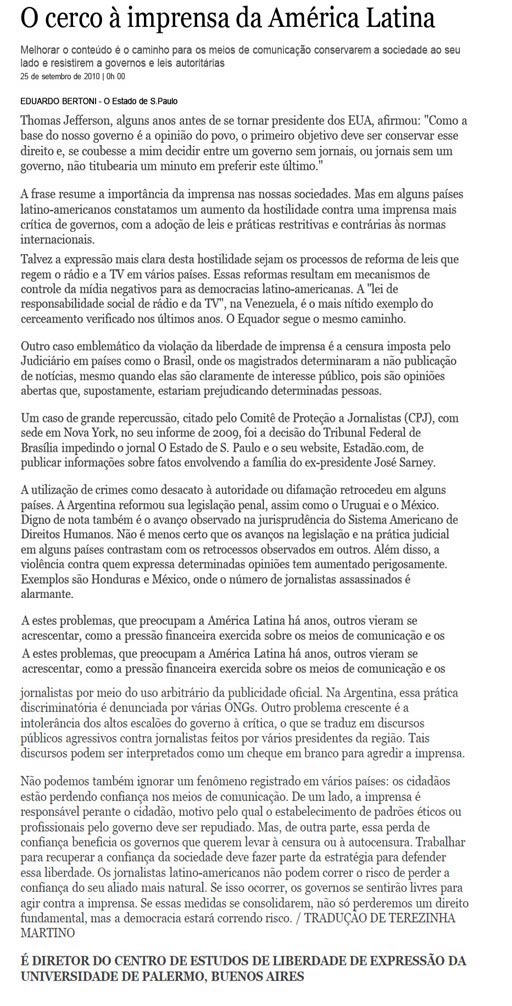
La situación de la Prensa en América Latina


 en Twitter @ebertoni. Eduardo Bertoni (Phd, Buenos Aires University) is currently the Director of the Center for Human Rights & Humanitarian Law, at the Washington College of Law, American University. Former Representative of the Regional Office for South America of the Inter American Institute of Human Rights. He was the first Director of the Access to Public Information Agency (AAIP) wich is the Argentine Data Protection Authority. He was the founder and first Executive Director of the Center for Studies on Freedom of Expression and Access to Information (CELE) at Palermo University School of Law, Argentina. Before returning to Argentina in 2009, he was the Executive Director of the Due Process of Law Foundation (DPLF) until May, 2006. Previously, he was the Special Rapporteur for Freedom of Expression of the Inter-American Commission of Human Rights at the Organization of American States (2002-2005).
2/2/10
Journalism in Latin America: Who Should Pay the Bill?
| ||
| ............................................................................................................................................................................... | ||
| Latin American countries need good quality journalism to protect, consolidate, and strengthen democracy. Historically associated to investigative journalists working for newspapers, good quality journalism is expensive and now faces serious challenges due to the unprecedented financial crisis affecting newspapers worldwide. If we agree that democracies need good journalism, somebody needs to pay the bill. The only realistic -- and unfortunately very risky -- means for newspapers' survival is to receive help from the state. None of the other options, including that readers pay for their papers, private advertisement, and revenues from an endowment, will work in Latin America. There has been an increase in the circulation of paid newspapers in several countries. Almost 2 billion people around the world read paid newspapers every day. However, revenues coming from subscriptions or daily payments are not enough to ensure papers' financial sustainability. Private advertisement has been falling dramatically. According to the World Association of Newspapers, only from 2008 to 2009, newspaper advertisement revenues dropped 21% in North America, 16% in Western Europe, and 6% in Latin America. This trend, which began some years ago, will continue while newspaper advertisement moves to the Internet, and the numbers of web advertisement continue to increase. The idea to transform newspaper companies into some sort of non-governmental organizations (NGOs) that would be supported by the revenues from a wealthy endowment will not work in Latin America. Such structure is possible in countries where a substantial group of people is willing to donate funds for this sort of projects, and where there are clear and predictable legal frameworks that allow for secure investments in a financial system such as a stock market. It is unlikely that this combination would exist in Latin America. But even if it did, the recent world financial crisis shows that this model is very risky. Many Latin American newspapers have been historically supported by state funds, specifically through public advertisements. But when a state pays for public advertisement, it is not promoting a public policy to ensure independent journalism -- it is simply paying the media to publish information that it believes should be in the public domain. In addition, a major problem with public advertisement, in practice, is that public officials in Latin America have typically allocated it in a discriminatory fashion, as an indirect sanction to papers with an editorial line critical of the government. So how should Latin American governments pay the bill? The focus should not be on allocating public advertisement, even if it is done in a transparent and non-discriminatory way. Governments must adopt clear public policies to strengthen democracies by, for example, granting subsidies and tax benefits in favor of newspapers. Clearly, the experience regarding how Latin American states have allocated public advertisement should serve as a model -- of what should not be done when drafting and implementing these new, necessary policies. |
 en Twitter @ebertoni. Eduardo Bertoni (Phd, Buenos Aires University) is currently the Director of the Center for Human Rights & Humanitarian Law, at the Washington College of Law, American University. Former Representative of the Regional Office for South America of the Inter American Institute of Human Rights. He was the first Director of the Access to Public Information Agency (AAIP) wich is the Argentine Data Protection Authority. He was the founder and first Executive Director of the Center for Studies on Freedom of Expression and Access to Information (CELE) at Palermo University School of Law, Argentina. Before returning to Argentina in 2009, he was the Executive Director of the Due Process of Law Foundation (DPLF) until May, 2006. Previously, he was the Special Rapporteur for Freedom of Expression of the Inter-American Commission of Human Rights at the Organization of American States (2002-2005).
26/9/06
Venezuelans harshly punished if they insult Chávez
The Miami Herlad
| |||||||||||
 en Twitter @ebertoni. Eduardo Bertoni (Phd, Buenos Aires University) is currently the Director of the Center for Human Rights & Humanitarian Law, at the Washington College of Law, American University. Former Representative of the Regional Office for South America of the Inter American Institute of Human Rights. He was the first Director of the Access to Public Information Agency (AAIP) wich is the Argentine Data Protection Authority. He was the founder and first Executive Director of the Center for Studies on Freedom of Expression and Access to Information (CELE) at Palermo University School of Law, Argentina. Before returning to Argentina in 2009, he was the Executive Director of the Due Process of Law Foundation (DPLF) until May, 2006. Previously, he was the Special Rapporteur for Freedom of Expression of the Inter-American Commission of Human Rights at the Organization of American States (2002-2005).
Suscribirse a:
Entradas (Atom)